In this article
After root canal treatment, some tenderness or mild pain when chewing for a few days is expected. This is because the tissues at the root tip become sensitive for a while after the procedure. The tenderness usually eases within days. If the pain keeps getting worse, or comes with swelling or fever, you should call the clinic.
- Tenderness when chewing in the first days is normal and usually eases on its own.
- Avoid chewing hard foods on that side until the permanent filling or crown is done.
- Call the clinic if the pain increases, your face swells, you have a fever or the tooth feels high when you bite.
- Once its restoration is complete, a root-canal-treated tooth is brushed and checked like any other tooth.
What is root canal treatment, in brief?
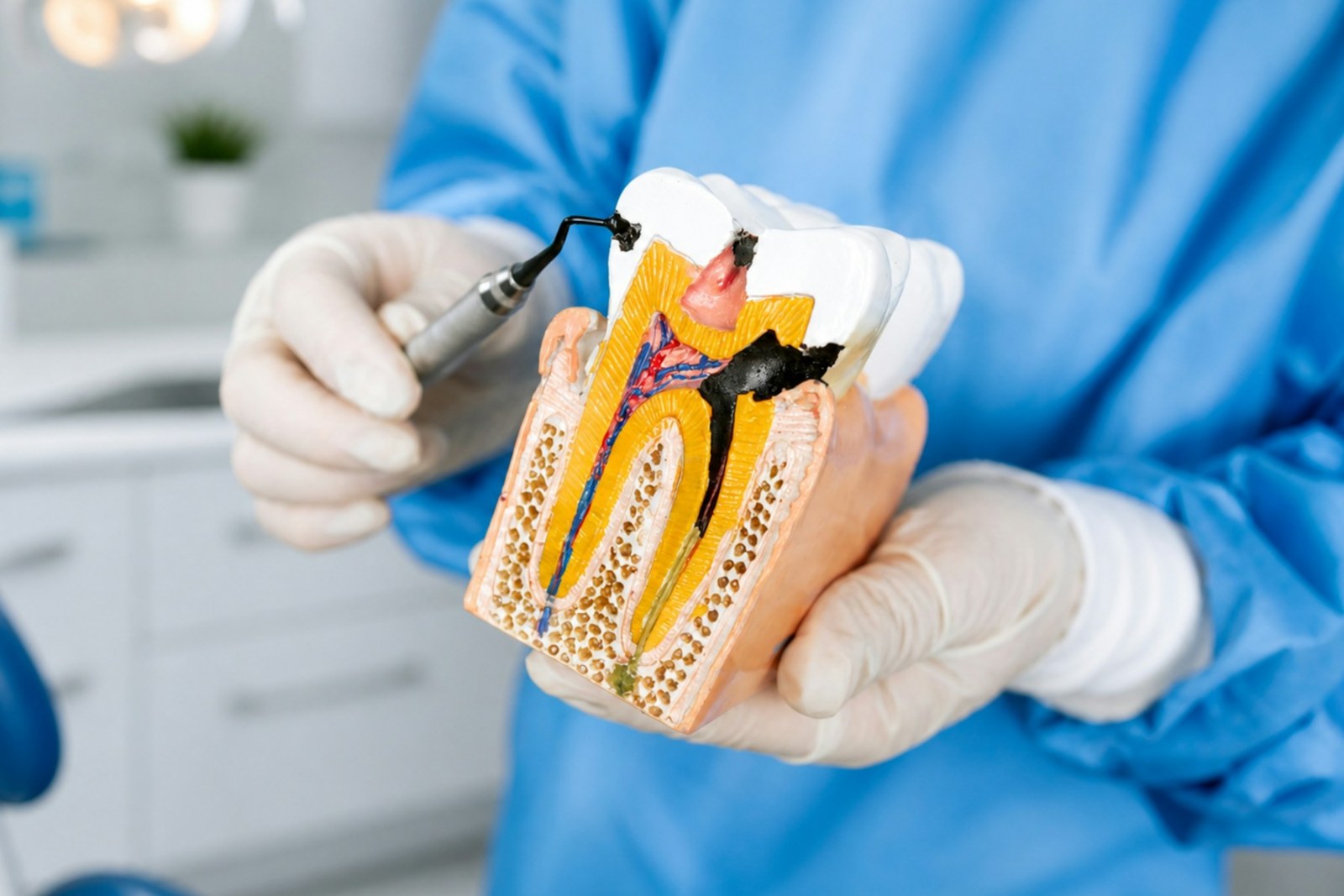
Root canal treatment
Cleaning out the tooth nerve (pulp) that has become inflamed or died because of deep decay, a crack or an injury, then shaping, disinfecting and filling the root canals. The aim is to keep the tooth rather than extract it.
How is root canal treatment done for people who are afraid of the dentist?
For people with severe dental fear (dental phobia) or a strong gag reflex, root canal treatment can be done under sedation or general anaesthesia. This way the patient goes through treatment with much less anxiety.
At our clinic, sedation and general anaesthesia are given by an anaesthetist, who monitors the patient’s vital signs throughout. How long the patient is kept asleep is planned according to the length of the treatment and their general health. The aim is to stop fear from causing treatment to be put off.
Anesthesiologist
Sedation and general anaesthesia are given under the supervision of an anaesthetist.
Less anxiety
Worry during treatment is clearly reduced.
One session
If needed, more than one tooth can be treated in the same session.
Why is there pain after treatment?
Tissues at the root tip
The tissues at the root tip can become sensitive for a while during canal cleaning.
High filling
If the temporary or permanent filling sits high in the bite, it can hurt when you bite.
Existing infection
If the infection was widespread before treatment, healing may take a little longer.
Crack
If the tooth has a crack, pain when chewing may continue; it is assessed at the examination.
How long does the pain last?
- 1First 24–48 hoursthe most noticeable period
Once the numbness wears off, there may be mild pain and tenderness when chewing.
- 2Within a few dayseasing
For most patients the tenderness gradually eases.
- 3Permanent filling or crownwithin 1–2 weeks
The tooth is protected permanently; it is important not to put off this appointment.
- 4Check-up X-ray6–12 months later
Healing at the root tip is followed up with an X-ray.
Is swelling normal after root canal treatment, and when does it go down?
Mild swelling of the gum around the treated tooth can be a normal reaction as the tissues heal. It is seen especially when the infection had reached the bone before treatment.

Mild swelling is expected to go down within a few days. Your dentist may recommend medicine if needed; applying cold to the cheek from the outside at intervals in the first 24 hours also helps. How long the swelling lasts varies from person to person, depending on how bad the infection was to begin with.
If the swelling keeps getting bigger, spreads across the face, makes it hard to swallow or breathe, or comes with a fever, contact your dentist without delay.
What should you watch at home?
- Take the painkiller your dentist recommends, as advised
- Don’t eat until the numbness wears off
- Brush the tooth gently, like your other teeth
- Come to your permanent filling or crown appointment
- Don’t chew hard foods on the treated side
- Don’t put pressure on the temporary filling; avoid sticky foods
- Don’t bite the numb area, and be careful not to burn yourself with hot drinks
- Don’t take antibiotics without asking your dentist
Call the clinic without waiting if you have: increasing pain, swelling of the face or gum, fever, a feeling that the tooth is high when you bite, or the temporary filling falling out.
What is root canal retreatment and why is it done?
Root canal retreatment means removing the old root filling from a tooth that was treated before but has not healed or has become infected again, then cleaning and filling the canals again.
Some teeth have extra canals that were not found in the first treatment and can cause infection over time. New decay or a broken filling on top can also let bacteria reach the root tip. If needed, the root structure is examined with a 3D CT scan; once the source of the problem is found, the canals are reshaped, disinfected and filled so they are sealed.
Root canal retreatment
Removing the old filling from a root-canal-treated tooth that has not healed or has become infected again, and redoing the treatment.
Why can a root-canal-treated tooth break?
Teeth that need root canal treatment have usually already lost tissue because of large decay or old fillings. That is why, especially for back teeth, protecting the tooth with a crown after treatment is often recommended. If the permanent restoration is put off, the tooth can break or bacteria can leak into the canal again.
If a root-canal-treated tooth hurts again years later, root canal retreatment is considered before extracting the tooth.
When are extraction and an implant considered instead of root canal treatment?
If the tooth is too broken down to be repaired, or the root has a crack or fracture, extraction followed by an option such as an implant is considered instead of root canal treatment.
The main aim is to keep your own tooth. But if the tooth is not strong enough to support a filling or crown, the decision may be to extract it. At our clinic, implants and surgery after extraction are done by our periodontist; planning is done by examining the bone with a 3D CT scan.
- Your own tooth is kept
- If the root is sound, a filling or crown is placed on top
- The surrounding tissues are preserved
- Considered for teeth that cannot be saved
- The missing tooth is replaced with an artificial root placed in the bone
- Neighbouring teeth are left untouched
Does your root-canal-treated tooth hurt?
Message or call us; we’ll listen to what’s happening and plan a check-up if needed.
You may also want to read: What is a dental cyst and how is it removed?.

Performs root canal treatment, retreatment and treatment of complex root structures at our clinic.
Frequently asked questions
Does root canal treatment hurt?
The procedure is done under local anaesthesia, so you feel no pain during it. If the numbing doesn’t work on a painful tooth, the dentist gives additional anaesthetic.
When can I eat after root canal treatment?
You can eat once the numbness wears off. Don’t chew hard foods on the treated side until the permanent filling or crown is done.
Can I take painkillers?
You can take the painkiller your dentist recommends, as advised. If you take other medicines, tell your dentist.
How many visits does root canal treatment take?
In most cases 1–2 sessions. The number of sessions may increase if the infection is widespread or retreatment is needed.
How long does a root-canal-treated tooth last?
With a good restoration, regular care and check-ups, it can be used for many years. It would not be right to give an exact figure.
Can root canal treatment be done during pregnancy?
Necessary dental treatment is usually planned in the second trimester, after consulting the obstetrician. In an emergency, treatment can be given under medical supervision so that the infection doesn’t harm the mother or baby.
Do I need a crown after root canal treatment?
For teeth that have lost a lot of tissue and have a higher risk of breaking, a crown is often recommended after root canal treatment. Depending on the tooth, a filling alone may be enough; the dentist decides after the examination.
Is a root-canal-treated tooth sensitive to hot and cold?
Because the nerve is removed in root canal treatment, sensitivity to hot or cold is not usually expected in a finished tooth. If sensitivity continues, let your dentist know.
This article is for general information and does not replace an examination. If your symptoms continue, see your dentist.